I made this widget at MyFlashFetish.com.

Sunday, April 8, 2012

FLIGHT ADAPTATIONS


FLIGHT ADAPTATIONS IN BIRDS

Flying is a balance between two sets of forces, lift and weight, and thrust and drag. Weight is the result of gravity and Lift is generated by the flow of air over the wings.  Bird wings are not flat but are concave below and convex above. The air that passes over the top of the wing has more distance to travel and thus it speeds up, causing the pressure to drop because the same amount of air is exerting its pressure over a greater area above the wing that below the wing. This effectively sucks the wing up. Meanwhile the air going below the wing has the opposite effect. It slows down, generates more pressure and effectively pushes the wing up. Hence a bird with air moving over its wings is pulled up from above and pushed up from below.  The low pressure of air on top of the wings represents a sink that the high pressure air under the wing tries to fill. This happens most along the thin trailing edges of the wing and causes a spiralling vortex of disturbance at the wing tip, which increase drag. Therefore, the most efficient wings are those which provide lift but reduce drag, such as the crescent shaped wings of swallows and swifts.

  Aerodynamic properties are measured by aspect ratio, which is the ratio of wing length divided by wing breadth. Long wings are better for gliding but harder to flap quickly and are therefore not much good at quick acceleration.  Wing loading is the relationship between total body-mass measured in grams versus total wing area measured in square centimetres. 

Non-flapping Flight or Gliding

Many soaring or gliding birds like vultures hang in the air and gain height without moving the wings.  Essentially this means that their wings generate a lot of lift without producing much drag. Large birds have evolved to be gliders partly because gliding becomes easier with larger wings and the mechanical flapping flight become harder with larger wings. With the exception of Hummingbirds, all birds glide to some extent when flying. As a rule, the smaller the bird, the shorter the distance it can glide and the faster it sinks. Gliding can be observed in game birds. A pheasant ascends from the ground like a rocket with fast wing beats and then glides for some distance down to the nearby woods.

Flapping Flight

Flapping flight is a more complicated process in which bird's wing changes shape and angle of attack during both the up and down stroke.  Flapping flight is basically rowing in the air with the added effort to generate lift as well. If a Blue Tit stops flapping its wings it better be about to land on a branch or it will fall to the ground. Flapping flight consists of two distinct movements: the power stroke and the back stroke. In the power stroke, the wings move forward and down; the back stroke returns the wings to the position from which the next power stroke will commence.

Soaring flight

Soaring differs from gliding flight in that the bird does nor lose altitude and sometimes even climbs up in air. When soaring, a bird uses no energy of its own; instead it depends on external forces called thermal currents, which are rising masses of air that form over areas where the ground warms up rapidly. Obstruction currents are produced when wind currents are deflected by mountains, cliffs, or tall buildings. The resulting upward rise of air lifts birds to high altitudes, providing a base for further gliding. Soaring birds always have large and broad wings, and the ratio of their body weight to the size of the airfoils is low.

Hovering Flight

In hovering flight, a bird generates its own lift by means of rapid wing beats. Holding its body nearly vertical, with its wings firmly flexed at the elbow joint, a hovering bird moves its wing surfaces forward and back in a horizontal plane; each of the two phases of the stroke generates lift. Hummingbirds’ wings are made in such a way that when in motion they act like lifting rotors. Their pointed wings do not flap and glide as other bird wings do, but propel them through the air by moving up and down, at a rate of 70 times a second. After feeding at a flower they can fly backward, climb vertically, turn at lightening speed, and come to a sudden standstill in midair. Hummingbirds have been known to fly up to speeds of 60 miles an hour and no bird of prey can ever catch a hummingbird in flight.

ANATOMICAL ADAPTATIONS

BODY SHAPE

            Birds have short, light and compact body as compared to other animals.
Most organs and large muscles are located near the center of gravity, which is slightly below and behind the wings to provide better balance during flight.

FEATHERS

Contour feathers cover the body and make it streamlined and decrease drag. Down feathers and soft and meant for insulation. Primary feathers are on the wings and are also called remiges, which help in flight and also provide wing shape. Tail feathers are called rectrices which stretch sideways so that tail can be used like a rudder for turning and balancing.

SKELETON

            The evolution of flight has endowed birds with many physical features in addition to wings and feathers. One way to reduce weight in birds is by the fusion and elimination of some unnecessary bones and the "pneumatization" of the remaining ones.  Not only are some bones of birds hollow but many of the larger ones are connected to the air sacs of the respiratory system. To keep the cylindrical walls of a bird's major wing bones from buckling, the bones have internal strut-like reinforcements. Fusion of bones in birds makes the skeleton light as well as strong. Coracoid, furcula, and scapula form a sturdy tripod for supporting the wings and broad surfaces for the attachment of large flight muscles.
            One key adaptation is the fusing of caudal bones into single pygostyle which supports the tail feathers. Birds also lack teeth or even a true jaw, instead having evolved a beak, which is far more lightweight.     
            Birds have uncinate processes on the ribs. These are hooked extensions of bone which help to strengthen the rib cage by overlapping with the rib behind them.
            Skull is composed of thin, hollow bones,which is extremely light in proportion to the rest of the body due to elimination of a heavy jaw, jaw muscles, and teeth. The job of chewing has largely replaced by the gizzard. The skull usually represents less than 1 percent of a bird's total body weight.

LIMBS
           
            Forelimbs (wings) are attached closer to center of gravity and farther from head than in other animals. The natural motion of wings is up and down, rather than back and forth. Forelimbs fold into a Z-shape and closer to the body. Hand bones are small, fused, flattened and specialized to manipulate the flight feathers. Aerodynamic shape of forelimb provides lift and propulsive force.

MUSCLES

            There are about 175 different muscles in the bird. They mainly control the wings, the tail, neck and the legs. The largest muscles in the bird are the muscles that control the wings. They are called the pectorals or the breast muscles, and make up about 15 – 25% of a bird’s full body weight. They make the birds’ wing stroke very powerful so that they can fly, and provide most of the movements the bird needs for its down stroke. The muscle below the pectorals is the supracoracoideus. It raises the wing when a bird is flying. The supracoracoideus and the pectorals together make up about 25 – 35% of the birds’ full body weight. Leg muscles are massive for bipedal locomotion but are tight and close to the body. Legs are tucked next to body in flight to reduce drag. Flight muscles are enormous as they have to generate thrust and vigorous movement of wings during flight.

DIGESTIVE SYSTEM

            Birds consume high-energy foods such as insects, seeds, fruits, meat, and nec- tar. The digestive system is extremely efficient in absorbing energy from small amounts of food at a rapid rate. Birds possess a gizzard that is composed of four muscular bands that act to rotate and crush food by shifting the food from one area to the next within the gizzard. Depending on the species, the gizzard may contain small pieces of grit or stone that the bird has swallowed to aid in the grinding process. Many birds possess a muscular pouch along the esophagus called a crop. The crop functions to both soften food and regulate its flow through the system by storing it temporarily.
RESPIRATORY SYSTEM
            The respiratory system of birds is adapted to the energy demands of flight. A bird's respiratory system is proportionately larger and much more efficient than in other animals, since flight is a more demanding activity than walking or running. An average bird’s respiratory system occupies about one-fifth of its body volume, while in an average mammal it is only about one-twentieth. Lungs of birds are less flexible, and relatively small, but they are interconnected with a system of large, thin-walled air sacs in the front and in the posterior portions of body. These, in turn, are connected with the air spaces in the bones.  Inhaled air passes first into the posterior air sacs and then, on exhalation into the lungs. When a second breath is inhaled into the posterior sacs, the air from the first breath moves from lungs into the anterior air sacs. When the second exhalation occurs, the air from the first breath moves from the anterior air sacs out of the lungs, while the inhaled air moves into the lungs. The air thus moves in one direction through the lungs. All birds have this one-way air flow system and many also have two-way flow system which may make up as much as 20 percent of the lung volume. In both systems, the air is funneled down into air capillaries carrying oxygen-poor venous blood. At the beginning of the tubules the oxygen-rich air is in close contact with that oxygen-hungry blood, while in distal tubules the oxygen content of air and blood are in equilibrium.  Birds’ respiration creates a "crosscurrent circulation" of air and blood, which provides greater capacity for the exchange of oxygen and carbon dioxide across the permeable respiratory membrane.

            Oxygen exchange occurs during both inhalation and exhalation. The posterior and anterior air sacs expand during inhalation. Air enters lungs via trachea. Half of the inhaled air enters the posterior air sacs, while the other half passes through the lungs and into the anterior air sacs. The sacs contract during exhalation. The anterior air sacs empty directly into the trachea, the posterior air sacs empty via the lungs into the trachea and to outside.

            Since during inhalation and exhalation fresh air flows through the lungs in only one direction, there is no mixing of oxygen rich air and carbon dioxide rich air within the lungs as happens in mammals. Thus the partial pressure of oxygen in a bird's lungs is the same as in the environment.

            Avian lungs do not have alveoli, as mammalian lungs do, but instead contain millions of tiny passages known as parabronchi, connected to air capillaries, where oxygen and carbon dioxide are exchanged with cross-flowing blood capillaries by diffusion. A diaphragm is absent in birds and instead the entire body cavity and air sacs act as bellows to move air through the lungs.
HEART
            Bird’s heart is large, powerful, four-chambered and of the same basic design as that of a mammal. The segregation of the two kinds of blood makes a bird's circulatory system, like its respiratory system, well equipped to handle the rigors of flight.
The flight muscles of most birds are red in color because of the presence of myoglobin and cytochrome. They are also richly supplied with blood and are designed for sustained flight. Light-colored muscles are found in pheasants, grouse, quail, and other galliformes birds. These are also well supplied with blood, are apparently capable of carrying a heavy work load for a short time, but fatigue more rapidly. A Ruby-throated Hummingbird's heart beats up to a rate of 1200 beats per minute (about 20 beats per second). The human heart weight amounts to 0.42 percent of body weight and the pulse rate at rest averages 72 beats per minute. The House Sparrow's heart constitutes 1.68 percent of the body weight and the pulse rate at rest averages 460 beats per minute. In the Ruby-throated Hummingbird these figures rise to 2.37 percent and a pulse rate of 615.


BLOOD

            Blood of birds has high blood pressure and high blood sugar, almost twice that of mammalian glucose levels). Fast flying and migratory birds have smaller red blood cells with greater surface-to-volume ratios for greater oxygen-absorbing capability.

BRAIN

            Brain is large with enormous cerebral hemispheres but the surface is white and without grey matter. Olfactory lobes are greatly reduced but optic lobes are excessively enlarged. Cerebellum is well developed with a median lobe, vermis and later lobes flocculi for coordination of muscular activity and balance.

EYES

            Eyes are large, with wide field of view and binocular vision. Nictitating membrane is transparent or translucent and covers the eye ball during flight. Sclerotic ring of bony plates protects the eye ball and increases the distance between the lens and retina for sharp distant vision. Birds have acute eyesight, with raptors having vision eight times sharper than humans. This is because of high density of photoreceptor cells retina (up to 1,000,000 per square mm in Buteos, against 200,000 in humans). An indented fovea on retina magnifies the central part of the visual field. Many species, including hummingbirds and albatrosses, have two foveas in each eye, and the ability to detect polarized light is also common in birds.

METABOLISM

Birds have high metabolism and endothermy for quick generation of power and for maintenance of high body temperature. Birds require large amounts of energy for flight, and need efficient oxygen circulation in high altitudes. The highest flight recorded for a bird was 11,274 m (37,000 ft.) when a Ruppell's griffon vulture collided into a commercial airline over western Africa (Martin, 1987).

            Birds normally maintain a body temperature of 38.0C to 42.0C (100.40F-107.60F) (Brooke and Birkhead, 1991).

REPRODUCTIVE SYSTEM

            Ovaries and testes are reduced in size except in the breeding season. Usually only one functional ovary is present in most of the birds and second ovary is greatly reduced to decrease the weight of body.  Female liver is displaced to the right to compensate for weight difference. But in the case of birds of prey generally both ovaries and oviducts are present. This is because during hunting these birds have to pounce on the prey with great force and struggling prey can kick and break the eggs in reproductive system. Eggs developing in two ovaries can compensate for this loss.

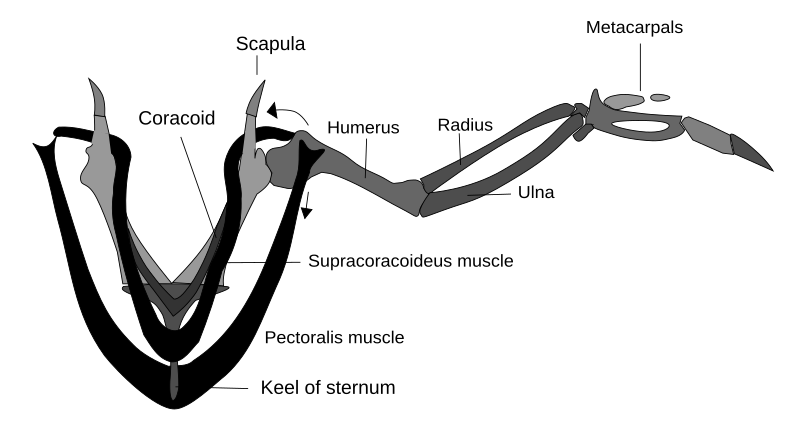
Respiratory System of Bird

File:WingMuscles.svgRespiratory System


Due to their high metabolic rate required for flight, birds have a high oxygen demand. Development of an efficient respiratory system enabled the evolution of flight in birds. Birds ventilate their lungs by means of air sacs.
These sacs do not play a direct role in gas exchange, but act like bellows to move air through the respiratory system, allowing the lungs to maintain a fixed volume with fresh air constantly flowing through them.[1]
Three distinct sets of organs perform respiration—the anterior air sacs (interclavicular, cervicals, and anterior thoracics), the lungs, and the posterior air sacs (posterior thoracics and abdominals). The posterior and anterior air sacs, typically nine, expand during inhalation. Air enters the bird via the trachea. Half of the inhaled air enters the posterior air sacs, the other half passes through the lungs and into the anterior air sacs. Air from the anterior air sacs empties directly into the trachea and out the bird's mouth or nares. The posterior air sacs empty their air into the lungs. Air passing through the lungs as the bird exhales is expelled via the trachea. Some taxonomic groups (Passeriformes) possess 7 air sacs, as the clavicular air sacs may interconnect or be fused with the cranial thoracic air sacs.
Birds lungs obtain fresh air during both exhalation and inhalation
As air flows through the air sac system and lungs, there is no mixing of oxygen-rich air and oxygen-poor, carbon dioxide-rich, air as in mammalian lungs. Thus, the partial pressure of oxygen in a bird's lungs is the same as the environment, and so birds have more efficient gas-exchange of both oxygen and carbon dioxide than do mammals. In addition, air passes through the lungs in both exhalation and inspiration.
Avian lungs do not have alveoli, as mammalian lungs do, but instead contain millions of tiny passages known as parabronchi, connected at either ends by the dorsobronchi and ventrobronchi. Air flows through the honeycombed walls of the parabronchi into air vesicles, called atria, which project radially from the parabronchi. These atria give rise to air capillaries, where oxygen and carbon dioxide are traded with cross-flowing blood capillaries by diffusion.[2]
Birds also lack a diaphragm. The entire body cavity acts as a bellows to move air through the lungs. The active phase of respiration in birds is exhalation, requiring muscular contraction.
The syrinx is the sound-producing vocal organ of birds, located at the base of a bird's trachea. As with the mammalian larynx, sound is produced by the vibration of air flowing through the organ. The syrinx enables some species of birds to produce extremely complex vocalizations, even mimicking human speech. In some songbirds, the syrinx can produce more than one sound at a time.

Dextrin and Oligosaccharide

Dextrin
Dextrins are a famile of polysaccharides which are obtained as an intermediate byproduct of the breakdown of starches. Many people treat dextrins like starches, since they behave in much the same way. Dextrins are used in a wide variety of industries, and they commonly appear as a food additive in a wide range of products, which can be problematic for some people, as they may contain traces of allergens like wheat or corn.
To make dextrins, a starch such as corn, sweet potatoes, tapioca, or corn is subjected to ahydrolysis process, which breaks down the long molecular chains in the starch. The resulting material is a dextrin, a simple carbohydrate with a low molecular weight which has properties which vary, depending on its precise chemical composition. Typically dextrins are dried so that they are easier to handle and ship; being water soluble, it is very easy to turn dextrins back into a wet solution.
The primary property of interest shared by dextrins is their potential as thickening and binding agents. Dextrins can be used to create glue, which explains why you may have heard about “wheat glue,” and they can also be added to foods to help them stick together. Dextrins may be included in some pharmaceutical preparations as well, helping to hold together the constituents of a pill. They are also used in research chemistry, and they pop up in some random places, like the field of pyrotechnics.
Oligosaccharide
Oligosaccharides are carbohydrates characterized by the simple sugars contained within each. This type of saccharide polymer is located in the amino acid side chains frequently found within vegetables ranging from onions to artichokes and jicama. Oligosaccharides are characterized by their sweet taste and unique mouth feel. These polymers are a source of controversy in the nutritional community because they contain both good and bad reactions within the human digestive system.
Oligosaccharides get their name from the Greek "oligos," which means "a few" and the Latin "sacchar," meaning "sugar". This type of saccharide polymer contains between three and ten simple sugars, also referred to as component sugars. These carbohydrates are an important part of plasma membranes and play a role in the cell-cell recognition within.
Animal plasma membranes are popular places for Oligosaccharides, but this carbohydrate type is most frequently found within plants. Some of the most common plants that house large amounts of Oligosaccharide are Jerusalem artichokes, chicory root, onions, wheat, legumes, asparagus and jicama. The Oligosaccharide is found in a vast array of other plants, but generally in smaller, negligible amounts. Strangely, the food production industry has begun using these carbohydrates as a synthetically added substitute for sugar in many products.

Thursday, April 5, 2012

Redox reactions

Oxidising and reducing agents

Oxidation is the loss of electrons by a substance during a chemical reaction. The substance which accepts these electrons is called the oxidising agent.
Reduction is the gain of electrons by a substance during a chemical reaction. The substance which donates these electrons is called the reducing agent.
The substances being oxidised and reduced, and the oxidising and reducing agents, can be identified in ionic equations.

Example:

Zinc metal can displace copper ions from a solution of copper(II) sulphate. Copper metal and a solution of zinc(II) sulphate are produced.
Ionic equation:
Zn(s) + Cu2+(aq) + SO42-(aq) → Cu(s) + Zn2+(aq) + SO42- (aq)
The equation shows that the zinc atoms (metal) have formed positively charged zinc ions, i.e., they have lost electrons. This means the zinc atoms have beenoxidised.
The positively charged copper ions have formed copper atoms, i.e., they have gained the electrons which the zinc atoms have lost. This means the copper ions have been reduced.
(The sulphate ions have neither lost nor gained electrons; they have not taken part in the reaction. They are spectator ions).
The copper ion is acting as the oxidising agent, because it has accepted electrons from the zinc atom, i.e., caused the zinc atom to be oxidised.
The zinc atom is acting as the reducing agent, because it has donated electrons to the copper ion, i.e., caused the copper ion to be reduced.

Example:

When chlorine reacts with iron(II) ions in solution, chloride ions and iron(III) ions are produced.
Ionic equation:
Cl2(g) + 2Fe2+(aq) → 2Cl-(aq) + 2Fe3+(aq)
The equation shows that the Fe2+ ions have formed Fe3+ ions, i.e., each ion has lost an electron. This means the Fe2+ ions have been oxidised.
The Cl2 molecules have formed Cl- ions, i.e., they have gained the electrons which the Fe2+ ions have lost. This means the Cl2 molecules have been reduced.
The Cl2 molecule is acting as the oxidising agent, because it has accepted electrons from the Fe2+ ions, i.e., caused the Fe2+ ions to be oxidised.
The Fe2+ ions are acting as the reducing agent, because they have donated electrons to the Cl2 molecule, i.e., caused the Cl2 molecule to be reduced.
Although oxidation and reduction happen together, they are often shown separately in ion-electron equations. Many of these equations are shown in the SQA data booklet, page 11. They are written as reductions, but can be reversed to give the oxidation equation.
When copper ions are displaced from solution by zinc atoms, the copper ions are reduced to copper atoms, so the ion-electron equation is written as it is in the data booklet:
Cu2+(aq) + 2e-→ Cu(s)
The zinc atoms are oxidised to zinc ions, so the ion-electron equation in the data booklet has to be reversed:
Zn(s)→Zn2+(aq) + 2e-
The reduction and oxidation equations can be added together to make the overall redox equation. Note: the electrons must be balanced.
Cu2+(aq) + 2e-→ Cu(s)    reduction
Zn(s) → Zn2+(aq) + 2e-  oxidation
Add: Cu2+(aq) + Zn(s)→Cu(s) + Zn2+(aq)    redox
If the electrons in the two ion-electron equations don't balance then the equations have to be multiplied to make them balance, before the two equations are added together.

Example:

When iron(III) nitrate reacts with sodium iodide, the iron(III) ions are reduced to iron(II) ions, and the iodide ions are oxidised to iodine molecules (the nitrate and sodium ions are spectator ions).
From the data booklet, the reduction equation is:
Fe3+(aq) + e-→ Fe2+(aq)
The oxidation equation is:
2I-(aq) → I2(s) + 2e-
The reduction equation has to be multiplied by two to balance the number of electrons in the oxidation equation.
2Fe3+(aq) + 2e-→ 2Fe2+(aq)
The balanced reduction and oxidation equations can now be added to give the redox equation.
2I-(aq)→ I2(s) + 2e-   oxidation
2Fe3+(aq) + 2e-→ 2Fe2+(aq)   reduction
Add: 2I-(aq)+ 2Fe3+(aq) → I2(s) + 2Fe2+(aq)    redox
A number of redox reactions will not take place unless there is acid present, the acid supplies hydrogen ions. During the reaction, these hydrogen ions react to form water.

Example:

Iron(II) ions are oxidised to iron(III) ions, by reaction with acidified potassium permanganate.
The reduction equation is in the data booklet:
MnO4-(aq) + 8H+(aq) + 5e-→ Mn2+(aq) + 4H2O(l)
This can be worked out in a number of steps, if the formulae of the main reactant and product in the reduction are known. In this example:
MnO4-(aq) → Mn2+(aq)
Step 1 Balance all the elements, except hydrogen and oxygen. In this case, there are the same number of 'Mn' on each side of the equation (one):
MnO4-(aq) → Mn2+(aq)
Step 2 If oxygen is unbalanced, add H2O to the side short of oxygen; in this case, the right-hand side (RHS). Multiply until the number of oxygens on each side is the same:
MnO4-(aq) → Mn2+(aq) + 4H2O(l)
Step 3 If hydrogen is unbalanced, add H+(aq) to the side short of hydrogen; in this case, the left-hand side (LHS). Multiply until the number of hydrogens on each side is the same:
MnO4-(aq) + 8H+(aq) → Mn2+(aq) + 4H2O(l)
Step 4 The total charge must be the same on both sides of the equation. Only electrons can be added to one side or the other. Balance the charge, by adding the appropriate number of electrons to the side which is short of negative charge; in this case the LHS:
MnO4-(aq) + 8H+(aq) + 5e-→ Mn2+(aq) + 4H2O(l)
The charge on the left-hand side = (one negative) + (eight positive) + (five negative) = two positive.
The charge on the right-hand side = (two positive) + (no charge) = two positive.

Example:

This example is not in the data booklet.
Br2(l) → BrO- (aq)
Step 1 Double the number of bromine oxide molecules on the RHS to balance the bromine on the LHS:
Br2(l) → 2 BrO- (aq)
Step 2 This time add H2O(l) to the LHS to balance the oxygens on the RHS:
Br2(l) + 2H2O(l) → 2 BrO- (aq)
Step 3Now add H+(aq) to the RHS to balance the hydrogens on the LHS:
Br2(l) + 2H2O(l) → 2 BrO- (aq) + 4H+(aq)
Step 4 Two electrons have to be added to the RHS, to make the overall charge zero, i.e., the same as the LHS:
Br2(l) + 2H2O(l) → 2 BrO- (aq) + 4H+(aq) + 2e-

The pH of salt solutions

The pH of a salt depends on whether the acid and base from which it is formed are strong or weak.

In general, the salt of a strong acid and weak base will form an acidic solution when dissolved in water.

Example: ammonium nitrate.

When ammonium nitrate dissolves in water, the following two equations are involved in producing the ions present in the solution:
NH4NO3(s) + H2O(l)→NH4+(aq) + NO3-(aq)
H2O(l)Forwards and backwards arrowOH-(aq) + H+(aq)
The NH4+(aq) and OH-(aq) ions produced are involved in an additional equilibrium for a weak base. The equilibrium position lies towards the formation of NH3(aq):
NH4+(aq) + OH-(aq)Forwards and backwards arrowNH3(aq) + H2O(l)
This additional equilibrium removes hydroxide ions, but not hydrogen ions. The water equilibrium shifts to the right, to replace these lost hydroxide ions and, in so doing, also produces more hydrogen ions. There are now more hydrogen ions than hydroxide ions present, leading to a pH of less than 7.
The salt of a weak acid and strong base will form an alkaline solution when dissolved in water.

Example: sodium ethanoate.

When sodium ethanoate dissolves in water, the following two equations are involved in producing the ions present in the solution:
CH3COONa(s) + H2O(l)→Na+(aq) + CH3COO-(aq)
H2O(l)Forwards and backwards arrowOH (aq)- + H+(aq)
The H+(aq) and CH3COO-(aq) ions produced are involved in an additional equilibrium for a weak acid. The equilibrium position lies towards the formation of CH3COOH(aq):
CH3COO-(aq) + H+(aq)Forwards and backwards arrowCH3COOH(aq)
This additional equilibrium removes hydrogen ions, but not hydroxide ions. The water equilibrium shifts to the right, to replace these lost hydrogen ions and, in so doing, also produces more hydroxide ions. There are now more hydroxide ions than hydrogen ions present, leading to a pH of more than 7.
Soaps are also salts of weak acids (such as stearic and oleic acid) and strong bases (such as sodium and potassium hydroxide). As a result, soaps are usually alkaline in nature.
The salt of a strong acid and strong base will form a neutral solution when dissolved in water

Example: sodium chloride.

When sodium chloride dissolves in water, the following two equations are involved in producing the ions present in the solution:
NaCl(s) + H2O(l)→Na+(aq) + Cl-(aq)
H2O(l)Forwards and backwards arrowOH-(aq) + H+(aq)
The ions present are not involved in an equilibrium associated with a weak acid or base.
The equal proportions of hydrogen ions and hydroxide ions in the solution are not disturbed by additional equilibria, and so the pH of the solution is equal to 7.